The Bible: The Living Legacy

Last Sunday, I visited the “Dead Sea Scrolls & the Ancient World” exhibition at The Arts House.

It was a good platform to gain a condensed overview of the bible’s history spanning over 5,000 years which included four fragments of the Dead Sea Scrolls, the oldest—known Hebrew manuscripts of the bible.

The Bible- God’s word

Growing up as Christian, I was taught that the bible was the word of God and the authority to which man should abide as their life and moral compass.

However, these claims remain both controversial and debatable. I guess this lies on the reason that the bible though inspired by God, was written through man.

But for me, I believe and I’m equally convicted of the bible’s claims as I have experienced how it has provided me much needed knowledge and insights to shape and transform my life for the better.

Personally, I think the bible is a living legacy that has been left for us to discover His promises and to understand His will towards a successful and powerful life.

The Bible- Eternal word

I found the exhibition rather helpful in appreciating the rich history that has went into the bible that we presently know and have today.

Indeed, the bible has endured the tests of time and prosecution (and will continue to).

In the past, only few elites had the privilege to read the bible. It was not not easily accessible to the common people for various practical and political reasons.

Things only change because of the many unseen and untold sacrifices (to the extend of death) of those that have gone before us. And today, all of us are able to freely read and learn the word of God.

But the irony of today’s reality is that majority of us neglect the reading and studying of the bible.

I mean if there are so many people who were willing and actually sacrificed their lives in order for us to read it, then there must be something in this book that is so important for us to know. No?

The bible, dead or alive? That’s left for each one of us to discover and decide.

Power To Get Wealth

Below is a daily devotional message (dated 25 March 2009) taken from Kong Hee’s website on truths about prosperity with a kingdom mentality.

 “And you shall remember the LORD your God, for it is He who gives you power to get wealth, that He may establish His covenant which He swore to your fathers, as it is this day.”

Deuteronomy 8:18

We all know that money can’t buy us happiness, a good name, a happy marriage or lasting friendships. Money certainly can’t buy us eternal salvation or the anointing of the Holy Spirit. But nevertheless, God still wants us to have money-the more the better!

There is a reason why Jesus, for your sakes, became poor that you, through His poverty, might become rich (2 Cor. 8:9). Deuteronomy 8:18 says that He gives you the power to get wealth for the purpose that His covenant with all mankind can be established.

So, the reason why God wants you to have money is so that you can use it to bring the gospel to the whole world. No wonder the psalmist says, “Let the LORD be magnified, who has pleasure in the prosperity of His servant” (Ps. 35:27).

Because the more we prosper financially, the more we can preach the good news and magnify our Lord. There are two contrasting covenants in the Old Testament. One is God’s covenant with Abraham which is eternal, and the other is God’s covenant with Moses which is temporal. Under the Abrahamic covenant, God blesses you to be a blessing to others. God told Abraham, “In you all the families of the earth shall be blessed” (Gen. 12:3).

But under the Mosaic covenant, there is another set of promises found in Deuteronomy 28. It is about God’s favor and blessing for our individual lives. Now, you have to be very careful which covenant you lock your mind onto.

If you focus exclusively on the temporal Mosaic covenant, you could become self-serving and greedy, and end up destroying your life. But if you mature to focus on the eternal Abrahamic covenant, then the more prosperous you are, the more you can be effective for the cause of the kingdom.

The truth is this: you can’t be a blessing if you haven’t been blessed. If you can’t even feed yourself, how are you going to feed the hungry? If you can’t even clothe yourself, how are you going to clothe the naked? If you have no money for your church projects and world missions, how are you going to take the good news to the world?

Meditate on this thought right now: “God has given me the power to get wealth, that I can use it to bring the gospel to the world!”

Singapore’s 40 Richest

The nation’s ecnomy is improving and so too are the fortunes of its richest tycoons as their total wealth has jumped 20%.

Singapore is emerging from its deepest recession since the island became an independent nation in 1965.

Though the economy may shrink up to 6% this year, there are signs that the worst is over. GDP expanded in the second quarter for the first time in a year.

Exports and manufacturing were up in July, and property prices and sales are picking up. The country’s main stock index has jumped almost 90% since its March low.

All of this has meant a boost in the fortunes of the nation’s richest. The total net worth of Singapore’s top 40 is $39 billion, up 20% from last year’s $32 billion.

Ng Teng Fong is No. 1 again, worth $8 billion, $1 billion more than last year. Kuok Khoon Hong’s net worth is up $2.2 billion to $3.5 billion, thanks in part to a 70% jump in the stock price of palm oil firm Wilmar International.

View the list of rankings of Singapore’s 40 richest here>>>

Prosperity comes from God

Be careful that you do not forget the LORD your God, failing to observe his commands, his laws and his decrees that I am giving you this day.

Otherwise, when you eat and are satisfied, when you build fine houses and settle down, and when your herds and flocks grow large and your silver and gold increase and all you have is multiplied, then your heart will become proud and you will forget the LORD your God, who brought you out of Egypt, out of the land of slavery.

You may say to yourself, “My power and the strength of my hands have produced this wealth for me.”

But remember the LORD your God, for it is he who gives you the ability to produce wealth, and so confirms his covenant, which he swore to your forefathers, as it is today.

Deuteronomy 8:6-14, 17-18 (NIV)

As He is, so am I…

Funny as this may sound, but I do find myself feeling guilty or embarrassed when I think I have received too much of God’s blessings or favour.

Have you felt the same way?

Responding to His blessings

I would also find myself in an uneasy situation where I would feel embarrassed to share those awesome testimonies with others when required to.

The common struggle would be my overly concern about what others might think of me and perceived that I am boasting or bragging.

This is especially so when it happens to be in the aspect of material/practical or financial prosperity.

I guess this might have to do with a wrong self-image or being rooted in a wrong theology towards finances that had not been addressed before.

However, I have being unlearning, re-learning and learning these matters and realised that I should neither deny nor be ashamed of His blessings and favour over my life.

By doing so, I would be de-valuing who I am as His child and not allowing Him to be fully and accurately reflected in my life.

Learning from Joseph

I read in the Bible that among all of Jacob’s sons, he doted and loved Joseph the most.

When Jacob gave Joseph a beautiful robe, he put it on despite knowing that it would have incurred the wrath of his brothers.

But he still did it because he was more interested in honouring his dad than gaining the approval of his brothers.

Likewise, I recognised that God loves me unreservingly. And His blessings and favour are bestowed upon me undeservingly.  This is for His glory, not mine.

More importantly, my self-image and identity are held up in God as His child; His beloved and anointed son.

As He is, so am I.

Updates on My New Job

Today marks the first month for me being in my new job.
My transition into this new organisation has been somewhat smooth with nice colleagues and an awesome office environment to boot.

This new job is a blessing. It was an unexpected ‘door’ opened as I was headhunted by my current employer.

Initially, I wasn’t interested in the job that was offered as I had just settled into my newly appointed marketing position then.

But after much prayer and deliberation, I saw it as His move and went ahead.

God is good. Taking that step of faith has led me to a promotion which also came with a generous increment.

But of cos, these are just some of the perks. More importantly, this has brought me another step closer to His plans for me.

Personally, this was clearly a miracle that had God’s finger prints all over.

This was His acceleration at work. And without His grace and favour, this would not have been possible.

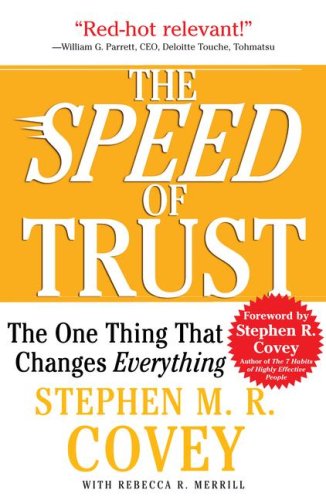
Title: The SPEED of Trust: The One Thing That Changes Everything
Author: Stephen M. R. Covey
Published: 2006
Genre: Business Management/Self-improvement
Ratings: 3.8 out of 5 stars

With our world greatly plagued by scandals and corruptions that have eroded the level of trust among people, this book is a timely read and attempt to put things right.

Trust being an integral element in relationships have often being taken for granted. In this era where there is a depper desire for accountability in governments, churches or any other organisations, this book by leadership expert Covey (son of Dr. Stephen Covey) is a welcome guide to nurturing trust in our professional and personal lives.

This book is well-researched and meticulous in its presentation which is very helpful in not only feeding the cognitive appettite, but it also provides practical steps in building a life of trust.

However, the book is awfully thorough that becomes too lengthy that it actually needs to. Still, this book makes a good read with great concepts such as trust being the “hidden variable” in the formula for organisational success.

The traditional business formula is: (Strategy x Execution = Results). But there is a hidden variable: (Strategy x Execution) x Trust = Results.

Interestingly, I realised that Singapore is one exception where this trust formula does not apply. Cos whether high or low trust, our government is still able to execute its strategies without any resistance. True? =p

Who should read it: Business-owners, leaders, management and PMETs. Also for those who like to develop personal character.

God’s Covenant with Us

Recently, I had a revelation that provided more insights about God’s covenant with us.

The seriousness of His covenant

The word “covenant” in its Hebrew meaning berith refers to something that has been “cut”.

This may explain why we have observed people cutting themselves when they enter into an oath or become sworn blood brothers.

That is why when the apostle Paul shared about the new covenant that was found in Christ, he was referring to Him as the ultimate sacrifice for the redemption of mankind.

It is through Christ with the shedding of His blood, that man is reconciled with God; altering man’s eternal destiny.

With a covenant requiring to cut or even to the extent of sacrificing one’s life, that shows how serious it is. Hence, a covenant serves as a seal between two parties that cannot be broken under any circumstances.

The paradox of His covenant

The amazing part of His covenant is when we consider the seriousness of a covenant, it seems entirely absurd that our Almighty God would even make an agreement with man.

I think we would agree that we would only go into an agreement with someone if we are confident of that person’s credibility which may be measured in terms of character or competence.

Taking into account the fallibility of man, it is obvious that God was taking a huge risk in trusting us to keep our end of the agreement when He initiated this covenant with us.

In fact, God was and is pretty much on the losing end.

But against conventional wisdom, we find that God trusts us. And more than that, He has remained faithful in spite of our shortcomings!

The message behind His covenant

Reflect for a moment on the fact that we or the Church have disappointed and grieved Him incessantly over spans of generations since the patriacrh Abraham, but yet He has remained true to His word.

Don’t you think it is mind-boggling that God would even intiate to establish a covenant with us?

“The Lord did not set his heart on you and choose you because you were more numerous than other nations, for you were the smallest of all nations!

Rather, it was simply that the Lord loves you, and he was keeping the oath he had sworn to your ancestors.”

Deuteronomy 7:7-8

The establishment of God’s covenant with us reveals the depth of His love for us. And it reminds us that He is faithful even when we may fail Him.

When we consider the extent of God’s love and magnanimity through His covenant with us, it also provides that much needed perspective for us in becoming more gracious towards others (even the Church) who might have hurt or even disappointed us.

Just as God displays unconditional love through His covenant, so should we as He is.

Religion, God & Other Separate Matters

Below is a blog entry from Mr Wang Says So. He provides an excerpt from a book that provokes thought and demands soul searching especially if we are Christians.

I shall quote a conversation between a certain old man and a certain young man, in a novel which I shall not name. What the book title is, and who the author is, is less interesting than the point which the fictional old man makes:

“Four billion people say they believe in God, but few genuinely believe. If people believed in God, they would live every minute of their lives in support of that belief. Rich people would give their wealth to the needy.”

Everyone would be frantic to determine which religion was the true one. No one could be comfortable in the thought that they might have picked the wrong religion and blundered into eternal damnation, or bad reincarnation, or some other unthinkable consequence. People would dedicate their lives to converting others to their religions.

“A belief in God would demand one hundred percent obsessive devotion, influencing every waking moment of this brief life on earth. But your four billion so-called believers do not live their lives in that fashion, except for a few. The majority believe in the usefulness of their beliefs—an earthly and practical utility—but they do not believe in the underlying reality.”

I couldn’t believe what I was hearing. “If you asked them, they’d say they believe.”

“They say that they believe because pretending to believe is necessary to get the benefits of religion. They tell other people that they believe and they do believer-like things, like praying and reading holy books. But they don’t do the things that a true believer would do, the things a true believer would have to do.

“If you believe a truck is coming toward you, you will jump out of the way. That is belief in the reality of the truck. If you tell people you fear the truck but do nothing to get out of the way, that is not belief in the truck. Likewise, it is not belief to say God exists and then continue sinning and hoarding your wealth while innocent people die of starvation. When belief does not control your most important decisions, it is not belief in the underlying reality, it is belief in the usefulness of believing.”

“Are you saying God doesn’t exist?” I asked, trying to get to the point.

“I’m saying that people claim to believe in God, but most don’t literally believe. They only act as though they believe because there are earthly benefits in doing so. They create a delusion for themselves because it makes them happy.”

“So you think only the atheists believe their own belief?” I asked.